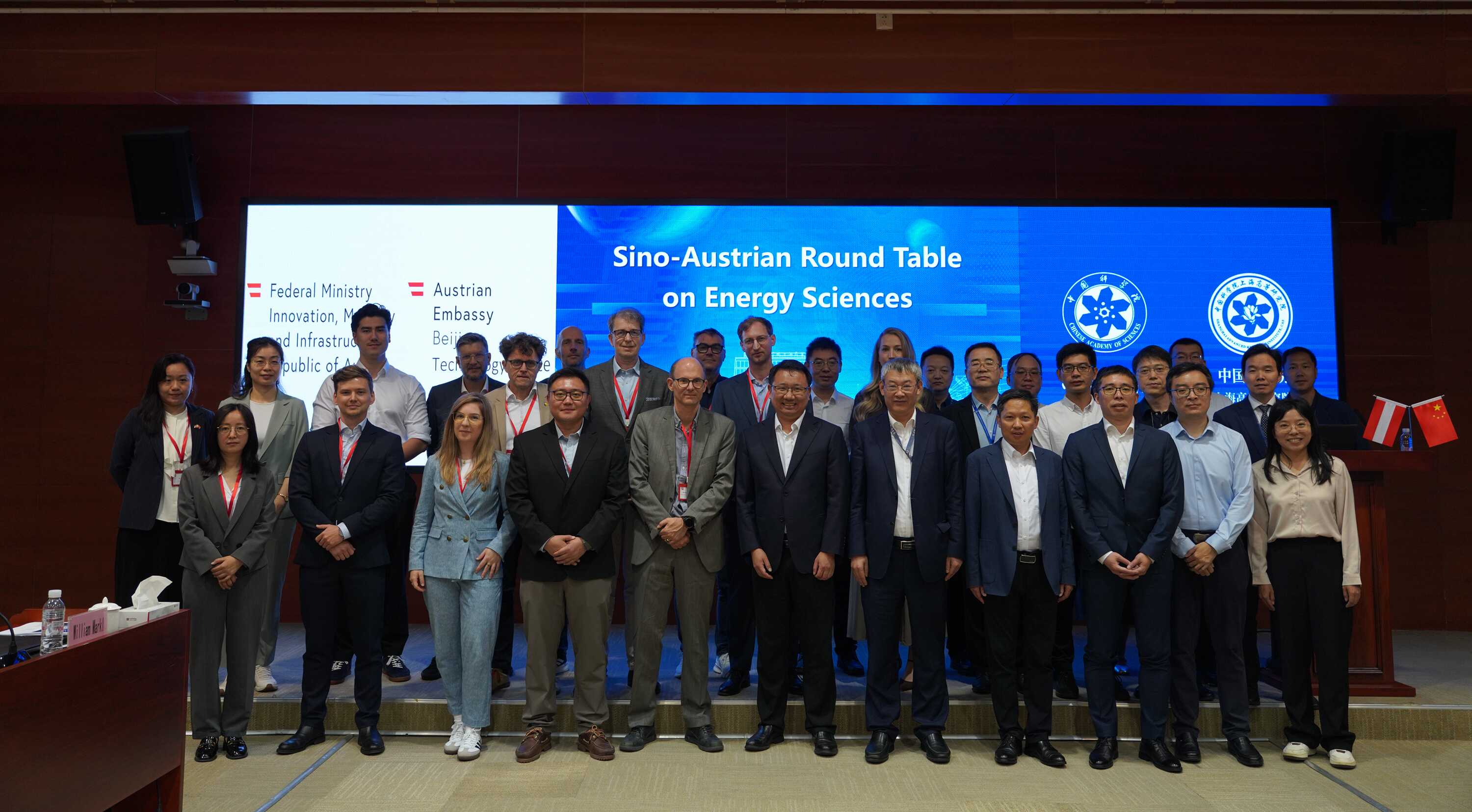
Sino-Austrian Round Table on Energy Sciences Held at SARI
On May 18, 2026, the Sino-Austrian Round Table on Energy Sciences was held at the Shanghai Advanced Research Institute of the Chinese Academy of Sciences (hereinafter referred to as 'SARI'). Nearly 40 representatives from the academia and industry attended the event, including Senior Officer of the International Cooperation Bureau of the Chinese Academy of Sciences Jiang Sanyuan, President of SARI Deng Haixiao and Vice President Wei Wei, Senior Policy Officer of Austrian Federal Ministry for Innovation, Mobility and Infrastructure Alexander Pogány, Head of Technology Office of Austrian Embassy Beijing Max Pfeiler. Wei Wei and Alexander Pogány jointly moderated the event.
Deng Haixiao welcomed the Austrian delegation and stated that energy transition is a global challenge. He noted that China and Austria have complementary advantages in the field of energy science with broad cooperation potential. He expressed hope that through exchanges, consensus could be built, practical cooperation advanced, and solutions provided to bilateral scientific cooperation and sustainable development for humanity. In his speech, Max Pfeiler stated that the Shanghai Advanced Research Institute has strong R&D capabilities in the energy field and shares many research directions with Austrian participants. He believed that this seminar would help deepen mutual understanding and lay a solid foundation for future project cooperation.
The Chinese and Austrian representatives gave keynote reports focusing on areas such as carbon science, energy systems, hydrogen energy, smart energy, and environmental protection solutions. They shared updates on research and industry development and engaged in discussions on topics of mutual interest. Following the roundtable, the delegation visited relevant laboratories, including the Shanghai Synchrotron Radiation Facility and the Center for Low-Carbon Conversion Science and Engineering, where they held in-depth exchanges on topics such as conducting energy science research using large-scale scientific facilities and reached broad consensus on cooperation.
 Appendix:
