SARI Participated in CIIF 2011
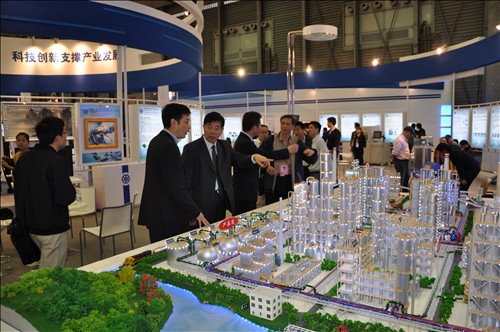
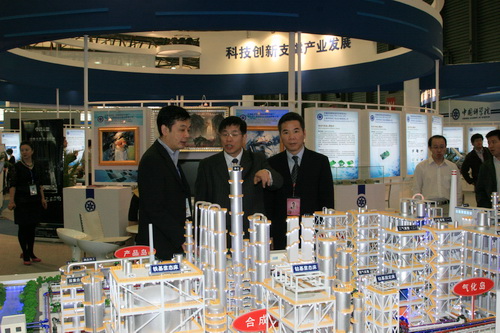
Before the opening ceremony, Mayor Han Zheng and Minister of Industry and Information Technology Ministry Miao Wei inspected CAS’s display area accompanied by Mr. Zhu Zhiyuan, Executive Vice President of CAS Shanghai Branch. Other leaders such as Director-General of CAS Academy-Locality Cooperation Bureau Qi Qiang also toured around CAS’S exhibition area that day.
The IGCC Project, aiming to establish China’s first demonstration park of low-carbon million-ton-scale combined production of gas, oil, fertilizer and power based on coal, is an integrated innovation case initiated by SARI and Shanxi Lu’an Group, and one of the major projects for Shanxi’s development transition during “the Twelfth Five-Year Plan” period. The IGCC Park demonstrates the theme of “combined use of one waste and three gases with coking and oil producing technologies” for development. It embodies the low-carbon energy cycling and innovative technology integration idea featured by resource integration, raw material diversification and high-end products. It also provides China’s economic development with a solution of clean energy chemical industry based on coal. The IGCC Park includes eight modules, i.e. raw material, coking technology, power technology, public usage, gasification technology, combination technology, product output and CO2 utilization. The eight modules are closely related to and combined with one another, thus forming the whole low-carbon energy cycling system.
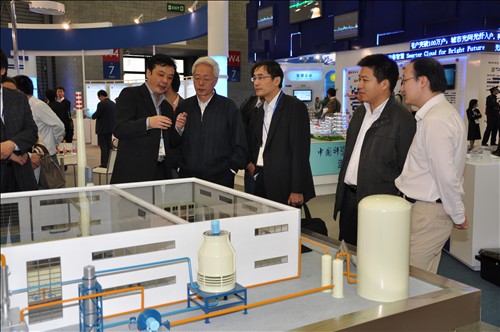
The Demonstration Project of Inner Circulation Pyrolysis and Charring Technology under Hypothermia-Hypoxic Conditions employs SARI’s related technologies to optimize the production procedures, saving the waste pre-classification procedure, realizing continuous material in and out, stabilized equipment operation, balanced thermal energy and its effective utilization, the use of small modular processing equipments, and meeting the emission standard. The technology enables macromolecular fracture of the organic components of the wastes under hypothermia hypoxic or oxygen-free conditions, generating flammable gas, organic tar and black charcoal. The black charcoal produced in this way is free from the secondary pollution by heavy metals. This technology has seen initial success in resource utilization of the wastes treated by it and experiments and research on bio-oil, bio-gas and bio-charcoal production have been conducted, which show a promising prospect.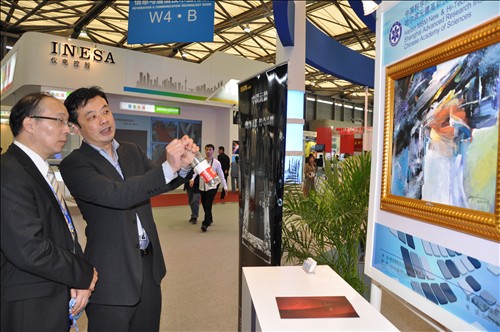
 Appendix:
 Prev
Prev
