360-Degree Rotating Beam Proton Therapy System Approved for Registration and Begins Treating First Batch of Patients
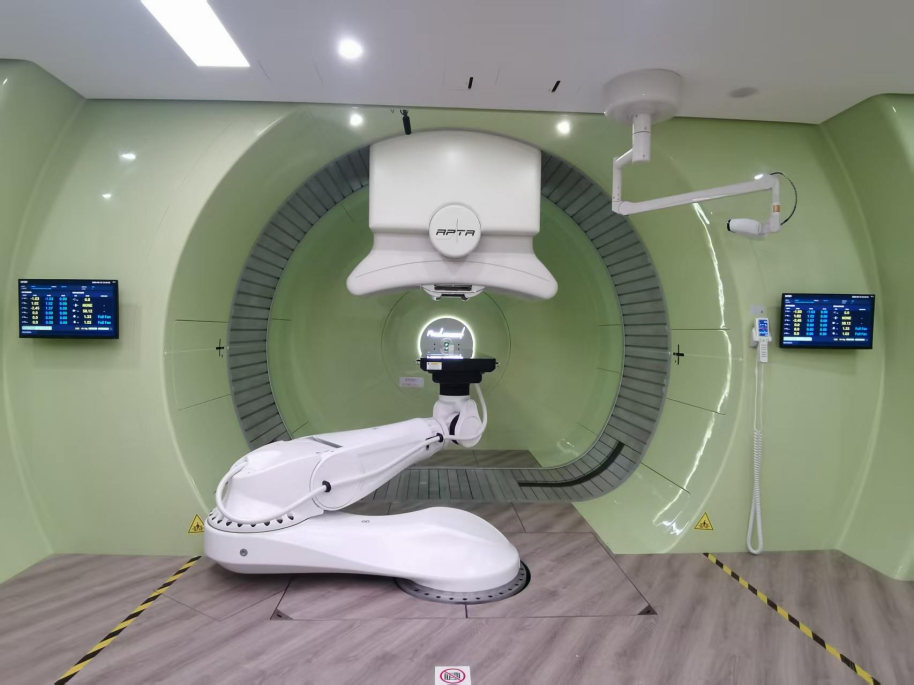
Recently, a 360-degree rotating beam proton therapy systemhas made significant progress, jointly developed by the Shanghai Advanced Research Institute of the Chinese Academy of Sciences (SARI), Shanghai Apactron Particle Equipment Co. Ltd. (APTR), the Shanghai Institute of Applied Physics of the Chinese Academy of Sciences (SINAP), and Ruijin Hospital affiliated with Shanghai Jiao Tong University School of Medicine. The system was officially approved for medical device registration by the National Medical Products Administration on May 8, 2026, and the first batch of patients successfully began treatment on May 12.
The 360-degree rotating beam spot-scanning therapy system, led by SARI, represents a major iterative upgrade based on the first registration unit (including fixed beam therapy systems and 180-degree rotating beam therapy systems). In addition to X-ray planar imaging positioning and respiratory gating functions, it has added an isocentric cone-beam CT subsystem based on the rotating gantry, enabling precise three-dimensional image-guided positioning and comprehensive multi-angle intensity-modulated treatment, significantly improving treatment accuracy and adaptability. This system is the first domestically developed 360-degree rotating beam proton therapy system to be registered with the National Medical Products Administration, achieving internationally advanced functionality and technical performance. The independently developed spot-scanning treatment head and cone-beam CT subsystem key performance indicators meet or exceed those of similar systems currently in use.
The first domestic proton therapy demonstration device has completed the technology R&D, type inspection, and medical device registration for the first and second registration units and has been put into clinical use. During this process, relevant technology transfer and commercialization were carried out concurrently, serving as a successful example of technological spillover from large accelerator scientific devices, effectively promoting deep integration of industry, academia, research, and medical practice, and facilitating breakthroughs in the localization and industrialization of high-end medical equipment. Currently, the proton device has successfully treated over 1,300 patients, covering more than 50 types of tumors, demonstrating the significant advantages of high-end medical equipment in precise, efficient, and low-side-effect treatment.
 Appendix:
