



Research Progress
On April 8th , the “ScienceOne–Yuheng Carbon Accounting Large Model” (hereinafter referred to as the “ScienceOne–Yuheng Model”) was released in Shanghai, which is the world’s first panoramic carbon emission accounting system covering production, consumption, and natural sources.
The ScienceOne –Yuheng Model precisely serves national needs for addressing climate change, marking a major technological breakthrough for China in the field of global carbon emissions accounting.
Carbon accounting serves as a critical basis for international climate compliance, a key foundation for global carbon pricing, and an essential prerequisite for achieving carbon peaking and carbon neutrality goals. Led by the Shanghai Advanced Research Institute of Chinese Academy of Sciences (CAS), the ScienceOne– Yuheng Model is designed to address longstanding challenges in traditional carbon accounting, including high knowledge barriers, difficulties in data processing, long calculation cycles, and low resolution.
By leveraging generative artificial intelligence, the model reconstructs the paradigm of carbon accounting, enabling dynamic tracking of global carbon flows and precise carbon tracing, thus significantly enhancing China’s scientific voice in global climate governance.
Built upon the “ScienceOne” developed by CAS, the ScienceOne –Yuheng Model adopts a three-layer technical architecture comprising data, algorithms, and computing power. The data layer is centered on eight categories of proprietary datasets developed by the research team and is continuously updated and integrated through collaboration with government departments and industry partners.
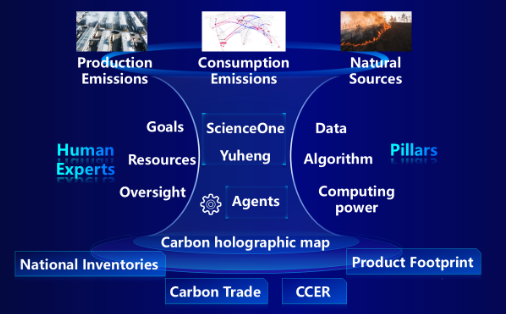
ScienceOne– Yuheng Carbon Accounting Large Model (Image by SARI)
The algorithm layer is driven by independently developed multi-boundary carbon accounting methodologies, featuring vertical-domain intelligent agents based on large language models and enabling multi-agent collaboration to ensure completeness and accuracy.
The computing layer integrates high-performance in-house server clusters with external computing centers to achieve globally optimized and elastic allocation of computing resources.
Application scenarios are key to unlocking the value of large models. The ScienceOne–Yuheng Model currently provides a user interface featuring a 32-billion-parameter domain-specific large language model, alongside conversational and programming interfaces connected to an intelligent database.
Five specialized intelligent agents have been developed to support functions including digital simulation and optimization of industrial systems, carbon transfer accounting in trade, life cycle assessment, natural source accounting, and uncertainty analysis.
Notably, the life cycle assessment agent can autonomously perform the entire workflow—from goal and scope definition to inventory analysis, calculation, and result interpretation—enabling fully automated product carbon footprint accounting.
High-quality datasets form the cornerstone of intelligent database querying, retrieval-augmented generation, natural language generation, and analytical validation capabilities. To meet application needs such as natural language querying, multi-database management, hybrid intelligent retrieval, and industry knowledge Q&A, the system integrates both internal and external datasets into a comprehensive, multi-dimensional data framework. Internal datasets focus on key business scenarios including production, consumption, natural sources, and carbon tracing, while external datasets encompass laws and regulations, accounting guidelines, industry knowledge, and third-party databases. To date, the system has aggregated 208 terabytes of multi-format carbon data.
Supported by unified processes for data collection, cleansing, governance, vectorization, and structured organization, the ScienceOne–Yuheng Model continuously improves data quality and knowledge utilization efficiency, providing a robust foundation for intelligent carbon data querying, knowledge reasoning, decision support, and scenario applications.
Leveraging this large model, researchers have preliminarily achieved high-resolution national-level carbon “holographic maps.” Taking 2022 as an example, under the newly developed scientifically robust accounting framework, greenhouse gas emissions for China, the United States, and Japan were adjusted by -17.7%, +15.2%, and +7.2%, respectively, compared with traditional IPCC production-based accounting results.
The model also reveals that the default emission factor system under the EU Carbon Border Adjustment Mechanism (CBAM) systematically overestimates the emission factors of Chinese products, underscoring the importance of improving accounting precision and adopting localized factors.
Furthermore, the model accurately quantifies the global emission reduction contributions of China’s green products. For instance, wind turbines and photovoltaic products exported by China in 2024 generated approximately 2 million tons of carbon emissions during production but contributed about 350 million tons of carbon emission reductions globally during their operation.
Panoramic carbon accounting is poised to become a core driver for advancing global climate governance toward greater precision and broader consensus. The CAS research team will continue to iterate and enhance the ScienceOne– Yuheng Model, developing proprietary algorithms, datasets, and reports with independent intellectual property rights.
The model is expected to provide strong support for major demands, including China’s national greenhouse gas inventory compilation, national carbon market construction, green transformation of key industries as well as responses to international carbon policies, contributing China’s expertise to building a more equitable and scientifically grounded global carbon accounting and responsibility-sharing framework.

Copyright Shanghai Advanced Research Institute, Chinese Academy of Sciences J ICP No. 05002857
Address: No.99 Haike Road, Zhangjiang Hi-Tech Park, Pudong Shanghai,P R China| Phone:021-20325000 | Email:sari@sari.ac.cn
